
Lesson 26: The One-Page Brief That Turns a Win Into Momentum
We cut rollbacks by seventy percent and almost nobody found out.
The release team knew. They’d lived it – three months of holding a boundary that felt restrictive at first and obvious by the end. Outside that team, the change was invisible. Support noticed fewer angry tickets without knowing why. Leadership had no idea a number had moved at all.
I’d written it up. Eleven pages, methodology, charts, appendix. It was thorough and nobody read it, which makes it worthless regardless of how thorough it was.
The Rule: An Unshared Win Is a Departmental Anecdote
Operational improvements don’t spread on their own. They sit inside the team that made them, and when that team’s people move on, the improvement leaves with them.
The thing that spreads a win is a document short enough that a busy person reads all of it. Not a summary of a long document – a short document. Those aren’t the same, and executives can tell the difference immediately.
A Real Example: Eleven Pages Down to One
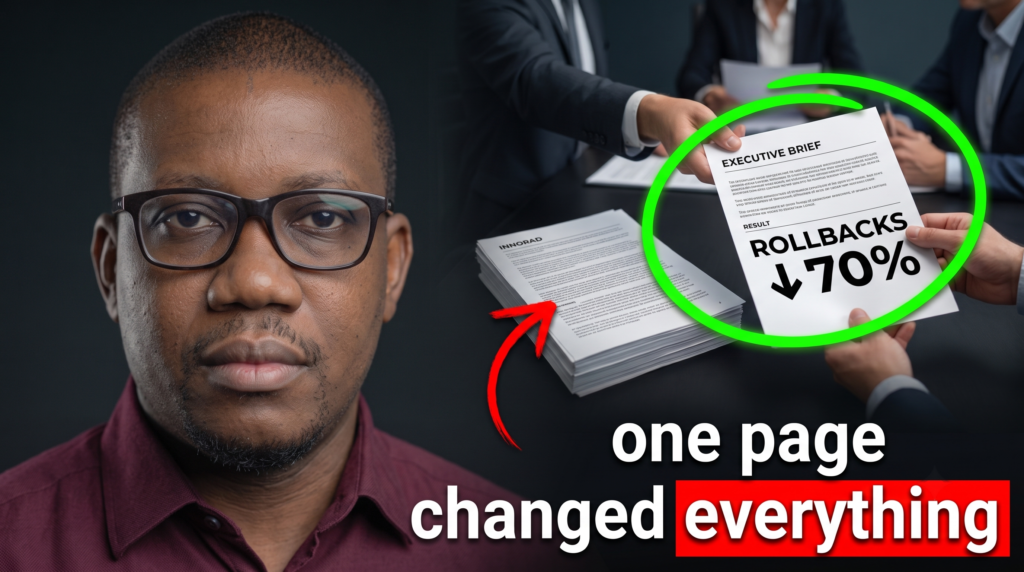
After the eleven-page report sank without trace, I rewrote the whole thing onto a single page with four blocks.
One sentence on the problem: releases were causing customer-visible failures and rollbacks were eroding trust between engineering and support. Three bullets on what we did: a three-item release boundary, a twenty-minute pre-release readout, a named comms owner on every change. One number, displayed large: rollbacks down seventy percent over ninety days, with mean time to resolve down about forty-five percent underneath it. Then the next step and who owned it.
Same day the thirty-day cycle closed, I sent it to the exec team and pinned it in the support and engineering channels.
A director quoted the rollback figure in a board meeting eight days later. Two teams asked whether the boundary model would work for their flows. One of them became the second pilot, which is the subject of the next lesson.
Identical work. Identical results. The only variable was packaging, and packaging turned a local win into an organizational one.
How To Do This Yourself
Four blocks. One page. No appendix.
- The problem, in one sentence. If it takes two, you don’t understand it well enough yet.
- What you did – three bullets, maximum. Not the journey. The changes.
- The result – one chart or one number, big. Resist the urge to include the other six metrics that also moved.
- Next step and the name of the person who owns it. A brief with no named owner reads as a victory lap.
Then send it the same day you close the cycle. Not next week when you’ve had time to polish it. The polish is worth less than the timing, because the moment people care about a result is when it’s just happened.
Send it to three audiences at once: execs, team leads, and the frontline channel where the work actually happens. That last one gets skipped constantly and it’s the one that builds trust, because the people who did the work get to see it land.
The Honest Lesson
I used to think the length of a report signalled how seriously I’d taken the work. Thirty pages meant rigour. It meant nothing of the sort – it meant I hadn’t done the harder work of deciding what mattered.
The other trap is tone. There’s a version of this brief that reads as self-promotion, and people can smell it instantly. The difference is small but total: describe what the system does now, not what you did. “Rollbacks are down seventy percent” lands. “I led an initiative that reduced rollbacks by seventy percent” makes people look for the flaw in your numbers.
And put the numbers you’re less proud of on the page too. If the signal improved but adherence was only at seventy percent, say so. The brief that admits something didn’t fully work is the brief people believe.
Take your most recent win – even a small one – and get it onto one page today. Send it before you’re happy with it.
Next time, I’ll dig into “Scale the 30-Day Playbook to a Second Flow” – see you there.